


Florida has one of the highest rates of drug-related treatment admissions in the country, and Palm Beach County sits at the center of a recovery ecosystem that has drawn men from across the United States. If you’re searching for drug rehab in South Florida, what you’re really searching for is a program that will actually work, and the difference between programs that do and don’t is more specific than most admissions websites will tell you.
Why south florida has become a destination for serious recovery
According to the Substance Abuse and Mental Health Services Administration (SAMHSA), Florida consistently ranks among the top five states for treatment admissions nationally, with the state’s 2022 data showing over 150,000 admissions to substance use treatment programs. Palm Beach County alone has become one of the most concentrated recovery corridors in the country, home to a range of programs from large clinical campuses to smaller, community-based residential facilities.
The draw isn’t just the climate, though year-round warmth does reduce the physiological stress of early withdrawal and supports outdoor therapeutic activity. The more substantive reason is density: South Florida has an unusual concentration of licensed, specialized facilities, credentialed clinicians, and established alumni networks. For men traveling from out of state, that ecosystem matters. You’re not just attending a program; you’re entering a community with decades of accumulated recovery infrastructure. The stakes of choosing wrong in this environment are real. A 30-day stay at the wrong facility can cost $30,000 or more in private pay, set back your recovery timeline, and deepen the cynicism that makes the next attempt harder.
What actually predicts success in drug rehab
A landmark study published in the Journal of Substance Abuse Treatment followed 1,326 adults through community-based treatment programs and found that three variables predicted long-term abstinence more than any others: treatment duration, individualized care planning, and integrated mental health support. Generic 30-day programs that offer the same curriculum to every client, regardless of substance, history, or diagnosis, consistently underperformed in follow-up assessments.
The practical translation: before you agree to anything, ask the admissions coordinator one question. “How does your clinical team individualize treatment planning for each client?” If the answer is vague or defaults to describing group programming, that’s diagnostic. A facility doing this right can tell you exactly how they assess each new client and how that assessment shapes the clinical plan.
Length of stay: why 30 days is usually not enough
The National Institute on Drug Abuse (NIDA) has published consistent findings that treatment lasting fewer than 90 days has limited effectiveness for most substance use disorders. The 90-day threshold isn’t arbitrary. During weeks four through eight, the brain’s dopamine regulation systems begin to stabilize, sleep architecture starts to normalize, and clients move from crisis management into genuine behavioral skill-building. Before week four, most men are still in acute neurological recovery, not yet capable of absorbing the cognitive and emotional work that produces lasting change.
Facilities that default to 30-day programs often do so for operational and financial reasons, not clinical ones. When evaluating any program in South Florida, ask for their average client length of stay and whether their structure accommodates extensions when clinically indicated. A program confident in its outcomes will answer both questions directly.
Dual diagnosis treatment: addiction and mental health together
SAMHSA’s 2022 National Survey on Drug Use and Health found that approximately 19.4 million adults in the United States had co-occurring substance use and mental health disorders. Among men specifically, depression, anxiety, PTSD, and untreated trauma are among the most common underlying drivers of addiction. Treating substance use without addressing those conditions is the single most predictable path to relapse.
True dual diagnosis treatment means a licensed psychiatrist is conducting evaluations and managing psychiatric medications on-site, not that a counselor occasionally discusses mental health topics in group. The distinction matters clinically. When you’re evaluating a facility, ask whether psychiatry is integrated into the primary treatment model or offered as a referral service. If a psychiatrist isn’t on staff, the program isn’t genuinely equipped to treat co-occurring conditions. For men exploring treatment options across Palm Beach County, this is one of the most important filters to apply early.
How to evaluate a drug rehab in south florida
The South Florida treatment market is one of the most competitive in the country, which means marketing sophistication often outpaces clinical quality. Luxury photography, vague promises of “holistic healing,” and high staff turnover are common. The framework below prioritizes criteria in order of clinical importance, not aesthetic appeal.
Accreditation and licensing: the non-negotiable starting point
Florida’s Agency for Health Care Administration (AHCA) licenses and regulates substance use treatment facilities in the state. Joint Commission accreditation (formerly JCAHO) is an additional voluntary standard that indicates a facility has met rigorous operational and clinical benchmarks. South Florida’s history with predatory treatment practices, including documented patient brokering schemes covered extensively by the Palm Beach Post, makes license verification the first thing you do before a single phone call.
The AHCA maintains a public database at floridahealthfinder.gov where you can search any facility by name and confirm its license status, license type, and any enforcement actions. This takes three minutes and filters out a significant portion of the market immediately. Facilities operating without a current, active license should be eliminated entirely, regardless of how their website presents.
Staff credentials and client-to-therapist ratios
A study published in the Journal of Consulting and Clinical Psychology found that therapist caseload size directly affects treatment outcomes: as caseloads increase beyond eight clients per therapist, therapeutic alliance scores drop and treatment retention declines. The mechanism is straightforward. A therapist carrying 15 clients can’t provide the depth of individual attention that drives behavioral change. One-hour sessions become intake-style check-ins instead of genuine clinical work.
When you visit a facility or conduct a phone consultation, ask directly: “How many clients does each primary therapist carry?” The honest answer for a high-quality program is six to eight. Ask also how many individual therapy sessions are included per week, not just group sessions. If individual therapy happens once a week or less, the program is group-dependent in a way that limits clinical depth. For men specifically researching treatment programs near Lake Worth, this ratio question is worth asking at every facility you contact.
Evidence-based treatment modalities
NIDA defines evidence-based treatment as interventions that have been tested in randomized controlled trials and shown to produce measurable reductions in substance use and relapse rates. The therapies with the strongest outcome data for addiction are Cognitive Behavioral Therapy (CBT), Dialectical Behavior Therapy (DBT) for emotional regulation, Eye Movement Desensitization and Reprocessing (EMDR) for trauma, and Medication-Assisted Treatment (MAT) for opioid and alcohol use disorders.
The red flag to watch for is facilities that lead with “experiential” offerings, equine therapy, art sessions, adventure programming, without being able to name the primary clinical modalities or provide outcome data. These activities aren’t necessarily harmful, but they’re not treatment. Ask any admissions coordinator to name the three primary clinical modalities used in their program and to describe how they measure client outcomes at 30, 60, and 90 days post-discharge. A facility tracking outcomes has the data; one that isn’t doesn’t.
Peer community and male-only environment
A 2019 study published in Substance Abuse: Research and Treatment examined outcomes across gender-specific and mixed-gender treatment programs and found that men in single-gender programs reported significantly higher rates of trauma disclosure, peer accountability, and treatment completion. The mechanism is consistent with what clinicians observe in practice: in mixed-gender environments, men frequently adopt performance-oriented behaviors that suppress the vulnerability required for genuine therapeutic work.
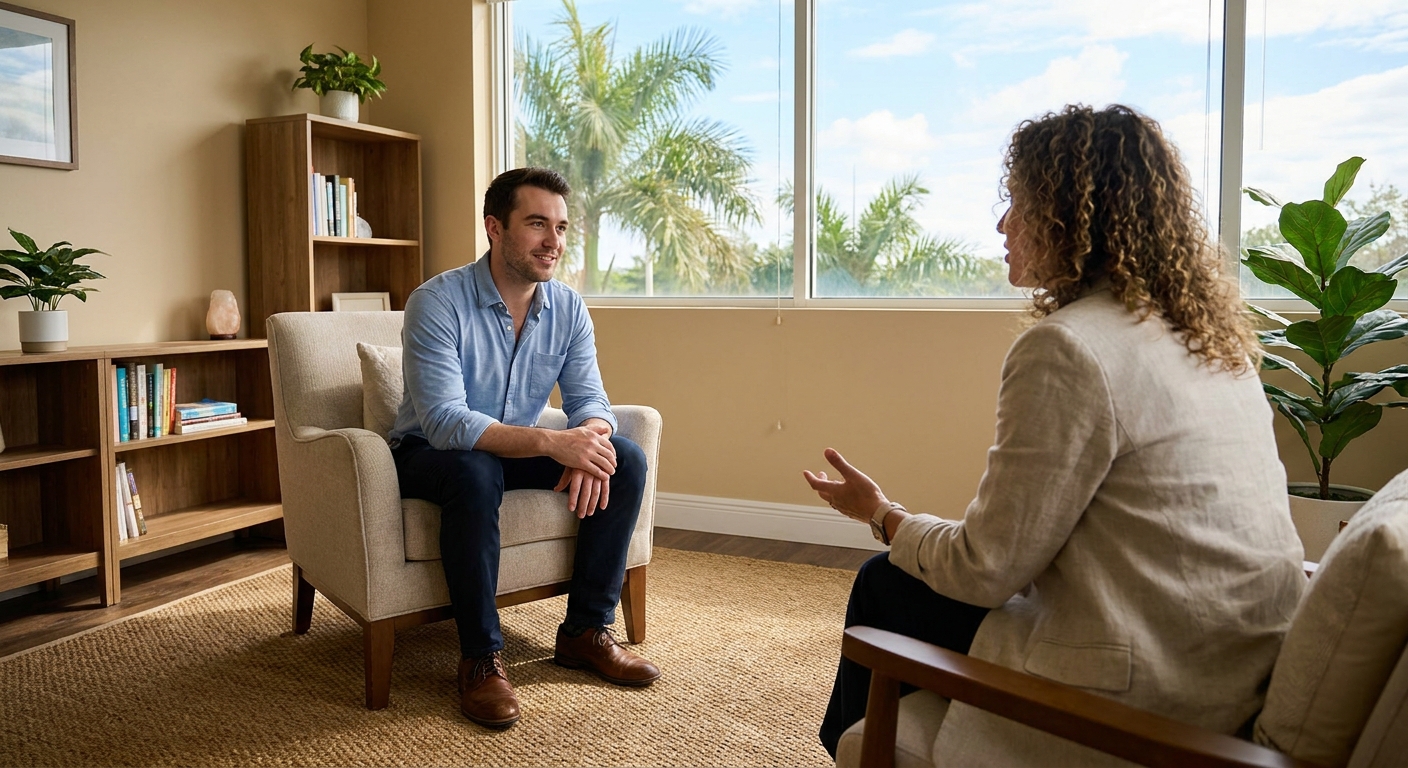
In an all-male program, group therapy dynamics shift. Conversations about shame, identity, family roles, and fear of failure land differently when every man in the room is contending with the same social conditioning. Before committing to any facility, ask to speak with an alumnus. Most reputable programs can connect you with a former client willing to speak honestly about the group experience. That conversation tells you more than any brochure.
Understanding insurance and private pay for south florida rehab
NIDA estimates the annual economic cost of substance use disorders in the United States at over $600 billion, including healthcare, lost productivity, and criminal justice costs. The out-of-pocket cost of a single 90-day residential stay ranges from $20,000 to $60,000 or more depending on the facility. The gap between those two numbers is often filled by out-of-network PPO insurance benefits, and understanding how those benefits work before your first admissions call is the difference between being reimbursed and being surprised.
How to use out-of-network PPO benefits
Out-of-network PPO coverage means your insurance plan pays a portion of costs at facilities outside its preferred network, after your deductible is met. The plan reimburses based on a percentage of “usual, customary, and reasonable” charges, which varies by carrier and geography. A “verification of benefits” call from a facility confirms that coverage exists, but it is not a guarantee of reimbursement. Benefits can be clawed back after the fact if documentation is insufficient or if the facility’s billing doesn’t match the clinical record.
Before calling any facility, pull three numbers from your insurance card: your out-of-network deductible, your out-of-network out-of-pocket maximum, and your plan’s reimbursement percentage for residential mental health and substance use treatment. These numbers determine your true financial exposure. Some facilities bill insurance directly and collect the remainder from clients; others require full payment upfront and provide a superbill for you to submit for reimbursement. Ask which model the facility uses on the first call. Men looking at treatment options in West Palm Beach will often find that the higher-quality programs work directly with PPO carriers and have billing staff experienced in navigating out-of-network claims.
Red flags: what to avoid in south florida’s treatment landscape
The Palm Beach Post’s investigative reporting on Florida’s “sober home” crisis documented a pattern of patient brokering, financial kickbacks for referrals, and facilities operating without legitimate clinical models. The problem has been partially addressed through state legislation, but predatory practices haven’t disappeared; they’ve become more sophisticated. Knowing what to look for protects you.
Watch for facilities that offer to waive your copay or deductible upfront, a practice that frequently signals insurance fraud. Be cautious of programs that can’t clearly name their clinical modalities or their outcome tracking methods. High staff turnover is a meaningful warning sign, ask directly how long the clinical director and primary therapists have been with the program. Luxury amenities marketed more prominently than clinical credentials suggest a business model built on attracting clients rather than retaining them through genuine recovery support.
The single most useful action: search the facility name in the AHCA database at floridahealthfinder.gov and look for any “complaint” or “enforcement action” records alongside the license verification. State enforcement actions are public and often reveal patterns that don’t show up in online reviews.
What recovery looks like after rehab: aftercare and continuity of care
NIDA reports that 40 to 60 percent of people with substance use disorders relapse at some point, but the data also shows clearly that structured aftercare dramatically reduces that rate. The difference between a facility that treats the acute crisis and one that builds a long-term recovery infrastructure is measurable in outcomes. A 2020 study in Drug and Alcohol Dependence found that clients engaged in step-down programming, meaning Partial Hospitalization (PHP) and Intensive Outpatient (IOP) following residential treatment, had relapse rates 35 percent lower than those who transitioned directly to independent living.
A strong aftercare plan includes a step-down path through PHP and IOP, coordination with a sober living environment if independent housing isn’t clinically appropriate, ongoing psychiatric medication management, alumni programming with real peer accountability, and a relapse response protocol in writing. Ask any facility for their written aftercare protocol before your first day, not on discharge day when you’re emotionally depleted and making decisions under pressure. If the facility can’t produce one, they aren’t treating recovery as a long-term process. Men evaluating programs in Palm Springs, Florida should ask specifically how local sober living networks are integrated into the discharge plan, as the quality of that coordination varies significantly between facilities.
The right step to take this week
Every other decision, which program, which insurance path, which level of care, depends on one thing first: confirming that the facility you’re considering is legitimately licensed and operating without state enforcement actions.
Go to floridahealthfinder.gov, use the facility search, enter the name of any program you’re considering, and confirm that the license status shows as “active.” Look at the license type to confirm it matches the level of care being marketed. Check for any complaint history or enforcement records. Then call the facility and ask for clinical outcome data at 90 days post-discharge.
Those two actions, license verification and outcome data, separate the programs worth your time from the ones that are not. Everything else in your evaluation builds from there.
Frequently asked questions
How long should drug rehab in south florida last?
For most substance use disorders, NIDA’s research supports a minimum of 90 days to produce lasting behavioral change. A 30-day program addresses acute detoxification and initial stabilization but doesn’t provide the time required for neurological recovery, trauma processing, or skill-building. When you evaluate any program, ask for their average length of stay and confirm that extensions are available when clinically indicated.
Does out-of-network PPO insurance cover residential rehab in south florida?
Out-of-network PPO plans typically cover a portion of residential treatment costs, but the specifics depend on your deductible, your plan’s reimbursement percentage for behavioral health, and how the facility bills. Before making any admissions call, confirm your out-of-network deductible, your out-of-pocket maximum, and your plan’s mental health and substance use reimbursement rate. A verification of benefits from the facility tells you what coverage exists; it does not guarantee reimbursement.
What is dual diagnosis treatment and why does it matter for men?
Dual diagnosis treatment addresses both a substance use disorder and a co-occurring mental health condition, such as depression, anxiety, PTSD, or trauma, simultaneously. SAMHSA data shows that nearly half of people with a substance use disorder have a co-occurring mental health condition. For men specifically, untreated depression, anxiety, and trauma are primary relapse drivers. A program without on-site psychiatric care isn’t equipped to treat the full picture.
What does a male-only rehab program offer that a mixed-gender program doesn’t?
Research published in Substance Abuse: Research and Treatment found that men in single-gender programs disclosed more, completed treatment at higher rates, and built stronger peer accountability. In mixed-gender settings, men tend to adopt performance-oriented behaviors that suppress the vulnerability necessary for genuine therapeutic progress. An all-male environment changes group dynamics in ways that are clinically meaningful, not just preferential.
How do I verify that a south florida rehab facility is legitimately licensed?
Go to floridahealthfinder.gov and use the facility search function. Enter the name of the program you’re considering and confirm that the license status is active, the license type matches the services being offered, and there are no enforcement actions on record. This search takes a few minutes and is the single most protective step you can take before investing time or money in any program.
What should a strong aftercare plan include?
A well-constructed aftercare plan addresses the transition out of residential treatment through step-down levels of care: Partial Hospitalization (PHP) followed by Intensive Outpatient (IOP). It includes coordination with a sober living environment if independent housing isn’t appropriate, ongoing psychiatric medication management, alumni programming for peer accountability, and a written relapse response protocol. Ask for the aftercare plan in writing before your first day of treatment, not on discharge day.