

A halfway house in South Florida is not the same thing as a sober living home, and that distinction can quietly determine whether someone rebuilds their life or returns to using within six months. If you’re evaluating options for yourself or someone you care about, understanding exactly what each term means, and what South Florida’s unique recovery market actually looks like, is the most useful thing you can do before making any calls.
What a halfway house actually is
A halfway house is a transitional residential setting designed to bridge the gap between a structured inpatient environment and fully independent living. The term originated in the mid-twentieth century as a descriptor for facilities that sat “halfway” between institutionalization and the community, and it has carried different legal meanings across different states ever since. In Florida, halfway houses are frequently associated with criminal justice referrals: court-mandated placements for individuals completing sentences or transitioning out of incarceration. That association matters, because it shapes the regulatory framework, the resident population, and the daily culture of the environment.
A halfway house is not a detox center, which manages acute withdrawal under medical supervision. It is also not a residential rehab program, where clinical treatment is delivered on-site throughout the day. The halfway house enters the picture after those earlier steps, once someone has stabilized and needs a structured setting to practice living sober before returning to the full weight of daily responsibilities.
How south florida’s recovery landscape changes the equation
A 2019 study published in the Journal of Substance Abuse Treatment, analyzing recovery housing outcomes across 300 participants in high-density recovery markets, found that geographic concentration of treatment options correlates with greater variability in quality, not greater average quality. South Florida, and Palm Beach County specifically, has become one of the most concentrated recovery markets in the United States. That density means more choices, but it also means more facilities operating across a wide spectrum of oversight, licensing, and genuine clinical integration.
The primary certification body for recovery residences in Florida is the Florida Association of Recovery Residences, known as FARR. FARR certification signals that a facility has undergone inspections, meets documented resident rights standards, and adheres to accountability models with demonstrated evidence behind them. In a market where facilities range from outstanding to predatory, FARR certification is the first filter worth applying. Verifying certification before touring a facility, not after, is the move that saves families from costly mistakes in a crowded and sometimes deceptive market.
Halfway house vs. sober living home: the distinction that matters
For families researching options, this is the most common source of confusion, and getting it wrong leads to poor placement decisions.
Licensing and oversight
Halfway houses in Florida tied to the criminal justice system carry state licensing requirements governed by the Department of Corrections or the Department of Children and Families, depending on the specific program type. Sober living homes certified by FARR operate under a different framework: voluntary certification, peer accountability, and house rules rather than court mandates. If you are evaluating a program for a man stepping down from residential treatment rather than completing a sentence, the facility you are probably looking for is a FARR-certified recovery residence, not a corrections-linked halfway house, even if the two terms are used interchangeably in casual conversation.
Structure and daily schedule
A halfway house connected to the corrections system typically enforces a regimented daily schedule driven by compliance: mandatory check-ins, supervised activities, curfews enforced through external authority. A quality FARR-certified sober living home structures the day around accountability and independence-building instead. Residents attend outpatient programming, 12-step or peer support meetings, and house meetings, while managing their own time between those anchors. The distinction matters because one model produces compliance and the other builds genuine self-regulation, which is the skill that actually sustains sobriety after the walls come down.
Peer support and community
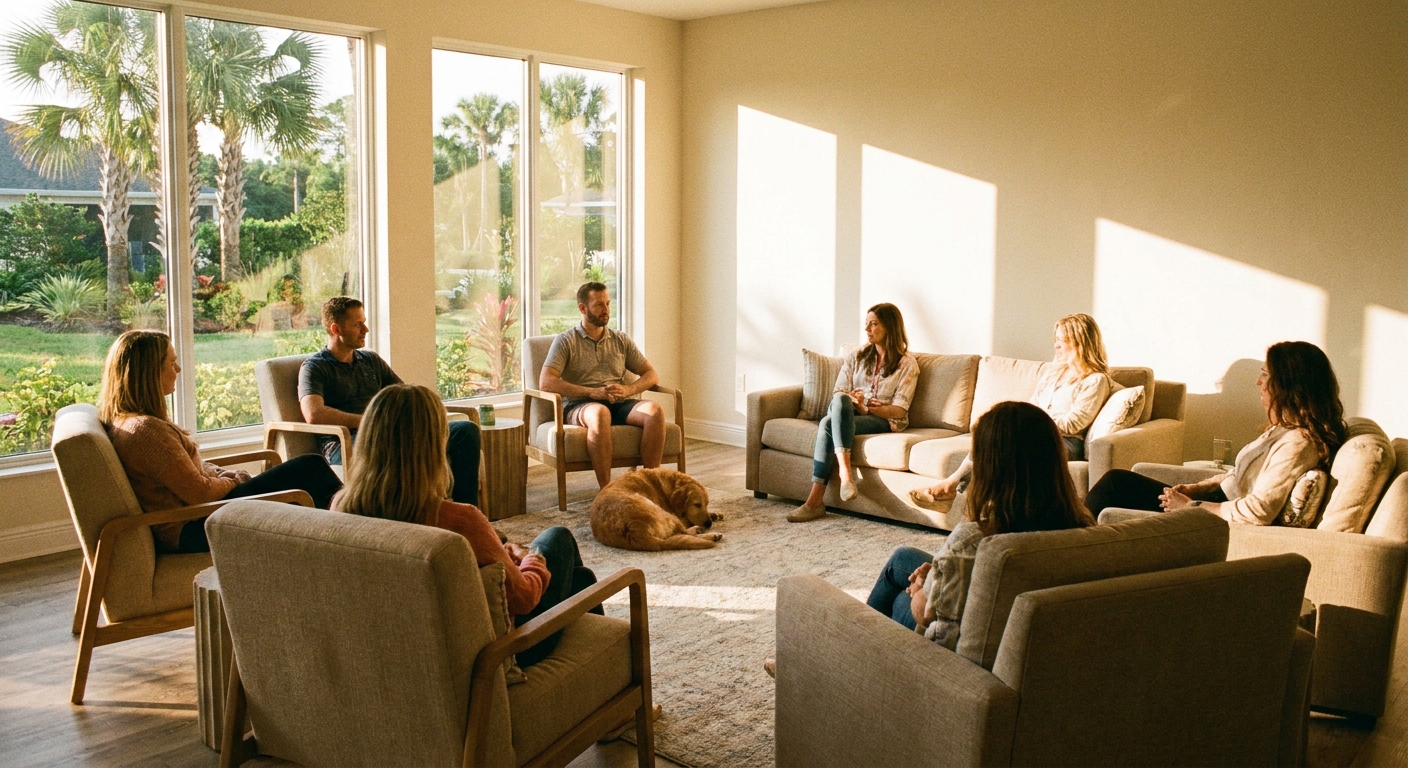
A 2016 study published in Substance Abuse, tracking 300 residents across Oxford House-model sober living homes over 24 months, found that longer exposure to peer accountability environments reduced relapse rates by 40% compared to residents who left within 90 days. In a sober living model, the community itself is the therapeutic mechanism. Residents hold each other accountable, share house responsibilities, and practice the interpersonal skills they will need in full independence. In a halfway house model tied to corrections, that dynamic is frequently absent because the population and motivations are different. The peer environment you choose directly affects relapse risk, and that is not a marginal variable.
The four levels of sober living in florida
FARR uses a four-level certification system to classify recovery residences by the intensity of support they provide. Level I homes are peer-run with minimal formal structure, appropriate for someone well into their recovery who primarily needs an accountable, sober living environment. Level II homes add paid staff, house managers, and more formal accountability systems. Level III homes include onsite services such as life skills programming and case management. Level IV homes offer clinical services on-site and are appropriate for someone stepping down directly from residential treatment who still needs clinical contact integrated into their daily environment.
If you are leaving a residential or partial hospitalization program, a Level III or Level IV certified residence is the appropriate match. Someone who has maintained sobriety for a year and primarily needs community and structure is better suited to a Level I or II home. Matching the level to the actual stage of recovery, rather than defaulting to whatever is geographically convenient, is the decision that makes the placement work. You can explore recovery residence options organized by care level across Palm Beach County to compare what each level looks like in practice.
What separates a quality halfway house in south florida from the rest
A 2017 Government Accountability Office report on recovery housing quality flagged South Florida specifically as a market where “patient brokering” and fraudulent billing practices had become documented problems, an industry pattern colloquially known as the “Florida shuffle.” The market has improved since then, but the variability remains significant. Knowing what to look for is not optional.
FARR certification and what it requires
FARR certification is not simply a house with a no-drinking policy and a sign on the door. It requires documented inspections, staff training standards, resident rights policies, and adherence to peer-accountability models with evidence behind them, such as the Oxford House framework. A FARR-certified home has met an external standard. One without certification has not, regardless of how its marketing describes its programming.
Insurance compatibility and private pay options
Many quality South Florida recovery residences work with out-of-network commercial PPO insurance. In practice, this means the facility bills your insurance company directly, and your responsibility depends on the specifics of your plan’s out-of-network benefits. Private pay is equally common, particularly for men seeking programs with stronger clinical integration. Confirm insurance compatibility before you schedule a tour. Discovering a billing incompatibility after you’ve emotionally committed to a placement creates unnecessary disruption during an already stressful process.
Location and environment
A 2015 study in Drug and Alcohol Dependence, examining environmental cues and relapse triggers across 450 participants in early recovery, found that geographic distance from the environments where substance use occurred was one of the strongest predictors of sustained abstinence at 12 months. The Palm Springs, Lake Worth, and Palm Beach County area offers a recovery setting that pairs structured programming with access to nature, strong outpatient networks, and established peer communities. For men traveling from out of state, that distance from home-environment triggers is a clinical advantage, not just a lifestyle preference. If you are specifically evaluating options in the area, what to look for in sober living near Lake Worth covers the local landscape in more detail.
What to expect as a resident
A quality South Florida recovery residence looks nothing like a dormitory where people happen to be sober. It is a structured, accountable environment designed to build the habits and skills that independent life requires.
House rules and accountability structures
Sobriety is non-negotiable, and that standard is maintained through regular drug testing. Beyond that, residents attend 12-step or peer support meetings, observe curfews, participate in house meetings, and share responsibility for common spaces through assigned chores. These are not punishments; they are the scaffolding that keeps early recovery intact long enough for the neurological and psychological changes of sobriety to take hold. The structure serves the resident, not the other way around.
Independence and life skills
Unlike inpatient treatment, a recovery residence requires residents to manage their own schedules, finances, and daily decisions within a supervised, sober environment. A 2014 study in the American Journal of Drug and Alcohol Abuse, following 150 men in recovery housing over 18 months, found that residents who engaged in formal life skills training during their stay reported significantly higher rates of employment and housing stability at the two-year mark. The friction of real-world responsibility, handled inside a safe structure, is what builds durable recovery. Programs integrated with clinical support, like The Palms Recovery’s sober living bridge model, use that daily friction intentionally as part of the therapeutic process rather than leaving residents to navigate it alone.
Length of stay
A 2010 study in Psychiatric Services, following 300 residents across multiple sober living homes over two years, found that stays of 90 days or more correlated with significantly better outcomes at 18-month follow-up across employment, sobriety, and legal status. The research is consistent: longer stays produce better results. Typical placements run 90 days to one year, depending on the level of care and individual clinical progress. Leaving against clinical advice is one of the most consistent predictors of relapse in the existing literature. That is not a warning to dismiss when things feel difficult inside the house.
How sober living fits into the broader continuum of care
A recovery residence is not a standalone intervention. It sits after medical detox and residential or partial hospitalization treatment, and before fully independent living, as one defined level in the continuum of care. The American Society of Addiction Medicine (ASAM) criteria provide the clinical framework that treatment teams use to match patients to the appropriate level of care at each stage of recovery.
The practical implication: discharge planning for sober living should begin before a client leaves residential treatment, not after. Leaving residential care without a confirmed placement creates a vulnerability window that relapse research consistently identifies as high-risk. Integrated programs that connect residential clinical services directly to structured sober living, such as the bridge model available to men at The Palms Recovery, close that window by design. If you are researching men’s recovery housing in West Palm Beach, understanding how clinical programming connects to residential support is the starting point.
What to try this week
Go to the FARR website today and verify whether any facility you are considering holds current certification. Enter the facility name in the registry and confirm its status before any further conversation with that program. In South Florida’s crowded market, that single check eliminates a significant portion of low-quality and non-compliant options. It takes three minutes and filters out the programs most likely to waste your time, your money, and the recovery window you are trying to protect.
Frequently asked questions
What is the difference between a halfway house and a sober living home in south florida?
In Florida, halfway houses are typically linked to the criminal justice system and carry state licensing requirements associated with corrections. Sober living homes certified by FARR are voluntary recovery residences that use peer accountability and structured house rules to support men stepping down from clinical treatment. Most men leaving residential or PHP programs are evaluating FARR-certified sober living homes, not corrections-linked halfway houses, even though the terms are often used interchangeably.
Does FARR certification actually matter when choosing a program?
Yes. FARR certification requires documented inspections, resident rights policies, staff training standards, and adherence to peer-accountability models with evidence behind them. A certified home has met an external standard verified by a third party. An uncertified home has not, regardless of what its website says about its programming. In a market with South Florida’s quality variability, FARR certification is the most reliable first filter available to families.
Will commercial PPO insurance cover a sober living placement in south florida?
Many quality South Florida recovery residences work directly with out-of-network commercial PPO insurance. The facility bills the insurance company, and the resident’s responsibility depends on their specific plan’s out-of-network benefits structure. Private pay is also widely accepted. Confirm billing compatibility before touring any facility to avoid disruption once you’ve committed to a placement.
How long should someone plan to stay in a halfway house or sober living home?
The research supports longer stays. Studies consistently show that 90 days is a minimum threshold for meaningful outcome improvement, and stays of six months to one year produce significantly better results in sobriety, employment, and housing stability at long-term follow-up. Leaving against clinical advice is one of the strongest predictors of relapse in recovery housing research.
Is south florida a good location for out-of-state men seeking recovery housing?
For men traveling from out of state, Palm Beach County offers genuine clinical advantages: geographic distance from home-environment triggers, access to strong outpatient networks, established peer recovery communities, and a setting that supports focus on recovery without the daily pressures of a familiar environment. A 2015 study in Drug and Alcohol Dependence identified geographic distance from prior use environments as one of the strongest predictors of sustained abstinence at 12 months.
What level of sober living is appropriate after residential treatment?
FARR’s four-level system matches residents to appropriate support intensity. Men stepping down directly from residential or PHP treatment typically belong in a Level III or Level IV certified residence, where onsite services, case management, and clinical integration are available. Level I and Level II homes are better suited for men further along in their recovery who primarily need accountability and community. Matching the level to the actual clinical stage, rather than cost or convenience, is what makes the placement productive.